Where the Education Dollars Go: How NYC’s Bilingual, Restorative Justice, and Special Education Budgets Leave Black and Afro-Latino Students BehindAdónde va el dinero de la educación: cómo los presupuestos de educación bilingüe, justicia restaurativa y educación especial de Nueva York dejan atrás a los estudiantes negros y afrolatinos
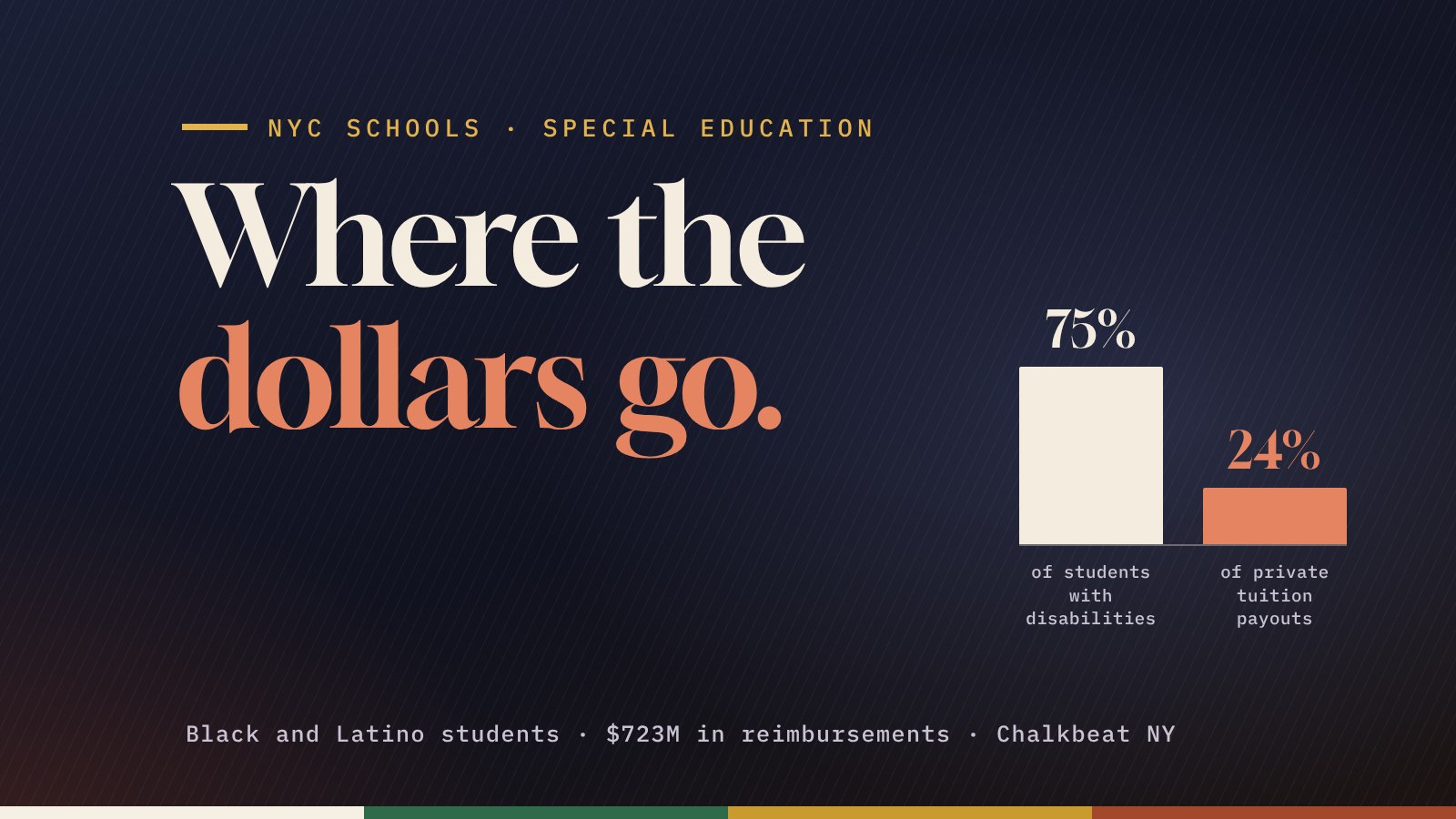
Black and Latino students are two-thirds of New York City’s public schools, yet they get a fraction of its richest programs. In special education, they are 75% of students with disabilities but received just 24% of $723 million in private tuition payouts.Los estudiantes negros y latinos son dos tercios de las escuelas públicas de Nueva York, pero reciben una fracción de sus mejores programas. En educación especial son el 75 % de los estudiantes con discapacidad, pero recibieron solo el 24 % de los 723 millones de dólares en reembolsos de matrícula privada.
 ByPor Dr. Richard Nuñez-Lawrence, Founding Executive Director, ALAPADirector ejecutivo fundador de ALAPA6 min readmin de lectura
In New York City Public Schools—the largest school district in the United States—Black and Hispanic/Latino students make up roughly two-thirds of total enrollment (23% Black and 43.2% Hispanic/Latino, according to U.S. News Education data). Yet when municipal education dollars are traced across classrooms, language programs, behavioral interventions, and special education placements, a stark contradiction emerges: the students who represent the overwhelming majority of the system receive a fraction of its most enriching resources, while bearing the brunt of its punitive tracking.
For Afro-Latino students, who sit squarely at the intersection of anti-Black racial bias and linguistic marginalization, the numbers tell a troubling story. Crunching 2025 and 2026 city budget data, academic proficiency reports, and civil rights audits reveals that Black and Latino students in New York City are systematically underserved across three critical pillars: bilingual education, restorative justice, and special education funding.
1. Academic & Opportunity Gaps: The Baseline Reality in NYC Classrooms
Before examining specific program budgets, citywide performance and admissions metrics show just how wide the resource gap remains across New York City’s segregated school system:
- 24-to-36-Point Proficiency Gaps: According to the 2026 New York City Racial Equity Plan, citywide proficiency among grades 3–8 students in the 2025–2026 school year reached 50.3% in English Language Arts (ELA) and 57% in math. However, ELA and math proficiency among Black and Latino students trailed their white and Asian peers by 24 to 36 percentage points. Even inside the city’s most demographically diverse schools, an October 2026 analysis reported by The Educators Room found that Black and Latinx students lagged 21 points behind in reading and 23 points in math.
- Exclusion from Elite Academic Tracks: During the 2026 specialized high school admissions cycle—reported by the New York Daily News—Black students received just 3.5% of the 4,023 offers and Hispanic students received 6.5%, even though they comprise nearly 66% of the school system. At Stuyvesant High School, only three Black students out of 777 received offers.
2. Bilingual & Dual-Language Education: Uneven Access and Program Closures
Multilingual learners—students speaking 156 languages—make up 44% of total NYC public school enrollment, according to data reported by Spectrum News NY1. Yet access to high-value Dual Language Bilingual Education (DLBE) programs—which build fluency in both English and a partner language like Spanish or French—is deeply uneven:
- Closures Outpacing Demand: While the city operates 566 bilingual and dual-language programs across 12 languages, Spectrum News NY1 noted that 62 bilingual programs were closed since June 2022 alongside severe shortages of certified bilingual teachers and limited family outreach.
- The Afro-Latino Exclusion: In practice, sought-after dual-language immersion seats in gentrifying neighborhoods in Brooklyn and Manhattan are frequently snapped up by affluent white families seeking enrichment for English-dominant children, while Afro-Latino students from Spanish-speaking Caribbean households or West African Francophone families in the Bronx and Central Brooklyn are funneled into under-resourced Transitional Bilingual or English-only tracks—or misclassified into special education.
- Curricular Erasure: Furthermore, standard Spanish-language curricula rarely reflect Afro-Latin American history, literature, or linguistic diversity, leaving Black Latino students alienated inside the very bilingual spaces meant to affirm their heritage.
3. Restorative Justice Funding: Proven Results, Threatening Budget Cuts
For more than a decade, civil rights advocates fought to replace zero-tolerance suspensions—which disproportionately push Black and Afro-Latino youth into the school-to-prison pipeline—with Restorative Justice (RJ) practices that address conflict through mediation, counseling, and relationship-building.
The data shows that restorative investments work when properly funded, yet municipal budget priorities have consistently left high-need schools shortchanged:
- Suspensions Drop When Restorative Programs Are Funded: According to data reported by Chalkbeat New York, total NYC public school suspensions fell 8% year-over-year in the first half of the 2025–2026 school year to roughly 9,200, with long-term superintendent suspensions plunging 22%—a drop officials credited directly to restorative practices, counseling, and mental health referrals. Similarly, an evaluation by the Urban Institute found that targeted suspension reforms cut Black students’ suspension rates by 8.8 percentage points and Hispanic students’ rates by 6.3 percentage points in pilot schools.
- Chronically Underfunded Implementation: Despite spending roughly $97 million between 2015 and 2024 across a system of over 1,600 schools—a figure examined by the Manhattan Institute—advocates with the Restorative Justice Initiative point out that NYC has never baselined the $120 million required to fully staff and train restorative coordinators across 500 high-need schools. Worse, as Chalkbeat New York reported in April 2026, Mayor Zohran Mamdani’s preliminary budget proposed cutting restorative justice and school mental health funding—threatening to reverse hard-won suspension reductions in Black and Latino neighborhoods.
4. Special Education: Over-Segregation and a $1 Billion Tuition Disparity
Nowhere is the misallocation of NYC public education dollars more glaring than in special education, where Black and Latino students are simultaneously over-referred into segregated classrooms and locked out of specialized private-school tuition reimbursements:
- Over-Representation in Restrictive Settings: In formal comments on the 2026 NYC Preliminary Racial Equity Plan, Advocates for Children of New York documented that Black and Latine students are disproportionately placed in restrictive, non-inclusive special education classes. Moreover, a November 2026 report analyzed by Skyer Law found that 85% of NYC students with disabilities come from low-income families, Black students are heavily over-represented in subjective “emotional disability” classifications, and students with emotional disabilities face a 13.1% suspension rate—nearly seven times the rate of non-disabled peers (1.9%).
- Over $723 Million Flowing to Wealthy White Families: While Black and Latino children make up 75% of all public school students with disabilities, a May 2026 investigation by Chalkbeat New York revealed that NYC paid out over $723 million in private special education tuition reimbursements (pushing total private tuition and service costs past $1 billion), with nearly 71% of those taxpayer dollars going to white students—who represent just 12.5% of disabled public school students. Black and Latino students received just 24% of those funds because low-income families lack the upfront cash and private legal representation needed to navigate the city’s complex “Carter case” reimbursement process.
Policy Solutions: Reclaiming Public Dollars for Black and Afro-Latino Students
To ensure Black, Latino, and Afro-Latino students actually receive the services their tax dollars fund, organizations like the Afro-Latino Association for Policy & Advocacy (ALAPA) and education justice coalitions are pushing City Hall and the State Legislature for four structural reforms:
- Disaggregate Student Data by Race and Ethnicity: Require NYC Public Schools to track and publicly report suspensions, dual-language enrollment, gifted admissions, and special education referrals using multi-select race and ethnicity data—making Afro-Latino students visible rather than hiding disparities inside broad “Hispanic” totals.
- Baseline $120 Million for Restorative Justice and School Counselors: Restore and permanently baseline funding for full-time restorative justice coordinators, social workers, and bilingual school psychologists in Title I schools across the Bronx, Central Brooklyn, and Upper Manhattan.
- Expand Equitable Dual-Language Access and Bilingual Teacher Pipelines: Reserve priority seats in Dual Language Bilingual Education programs for emergent multilingual learners from low-income Black and Latino households, invest in bilingual teacher-certification scholarships, and embed Afro-Latino history across K–12 curricula.
- Overhaul Special Education Funding: Redirect a portion of the $1 billion spent on private special education tuition payouts into high-quality, integrated public school special education programs in Black and Latino districts—and provide free legal and translation navigation for low-income families seeking specialized services.
Dr. Richard Nuñez-Lawrence is the founding Executive Director of the Afro-Latino Association for Policy and Advocacy (ALAPA).
En las Escuelas Públicas de la Ciudad de Nueva York —el distrito escolar más grande de Estados Unidos—, los estudiantes negros e hispanos o latinos representan aproximadamente dos tercios de la matrícula total (23 % negros y 43,2 % hispanos o latinos, según datos de U.S. News Education). Sin embargo, cuando se sigue el rastro del dinero municipal para la educación por las aulas, los programas de idiomas, las intervenciones de conducta y las asignaciones de educación especial, aparece una contradicción evidente: los estudiantes que forman la inmensa mayoría del sistema reciben una fracción de sus recursos más enriquecedores y cargan con el peso de su clasificación punitiva.
Para los estudiantes afrolatinos, que se encuentran justo en la intersección del sesgo racial antinegro y la marginación lingüística, las cifras cuentan una historia preocupante. El análisis de los datos presupuestarios de la ciudad de 2025 y 2026, los informes de rendimiento académico y las auditorías de derechos civiles revela que los estudiantes negros y latinos de Nueva York reciben sistemáticamente menos servicios en tres pilares fundamentales: la educación bilingüe, la justicia restaurativa y el financiamiento de la educación especial.
1. Brechas académicas y de oportunidades: la realidad de base en las aulas de Nueva York
Antes de examinar presupuestos de programas específicos, los indicadores de rendimiento y de admisión de toda la ciudad muestran lo amplia que sigue siendo la brecha de recursos en el sistema escolar segregado de Nueva York:
- Brechas de rendimiento de 24 a 36 puntos: Según el Plan de Equidad Racial de la Ciudad de Nueva York de 2026, el rendimiento satisfactorio de los estudiantes de 3.º a 8.º grado en toda la ciudad durante el año escolar 2025–2026 llegó al 50,3 % en Artes del Lenguaje en Inglés (ELA) y al 57 % en matemáticas. Sin embargo, el rendimiento en ELA y matemáticas de los estudiantes negros y latinos quedó entre 24 y 36 puntos porcentuales por debajo del de sus pares blancos y asiáticos. Incluso en las escuelas con mayor diversidad demográfica de la ciudad, un análisis de octubre de 2026 publicado por The Educators Room encontró que los estudiantes negros y latinos estaban 21 puntos por detrás en lectura y 23 en matemáticas.
- Exclusión de las vías académicas de élite: En el ciclo de admisión a las escuelas secundarias especializadas de 2026, según informó el New York Daily News, los estudiantes negros recibieron apenas el 3,5 % de las 4.023 ofertas y los hispanos el 6,5 %, aunque representan casi el 66 % del sistema escolar. En la escuela secundaria Stuyvesant, solo tres estudiantes negros de 777 recibieron ofertas.
2. Educación bilingüe y de lenguaje dual: acceso desigual y cierre de programas
Los estudiantes multilingües —que hablan 156 idiomas— representan el 44 % de la matrícula total de las escuelas públicas de Nueva York, según datos de Spectrum News NY1. Sin embargo, el acceso a los valiosos programas de Educación Bilingüe de Lenguaje Dual (DLBE), que desarrollan la fluidez tanto en inglés como en un idioma asociado como el español o el francés, es muy desigual:
- Cierres que superan la demanda: Aunque la ciudad opera 566 programas bilingües y de lenguaje dual en 12 idiomas, Spectrum News NY1 señaló que se han cerrado 62 programas bilingües desde junio de 2022, en medio de una grave escasez de maestros bilingües certificados y de un alcance limitado a las familias.
- La exclusión afrolatina: En la práctica, los codiciados cupos de inmersión en lenguaje dual en barrios en proceso de gentrificación de Brooklyn y Manhattan suelen quedar en manos de familias blancas acomodadas que buscan enriquecer la educación de hijos cuyo idioma dominante es el inglés, mientras que los estudiantes afrolatinos de hogares caribeños hispanohablantes o de familias francófonas de África Occidental del Bronx y el centro de Brooklyn son canalizados hacia programas de Bilingüismo de Transición o de solo inglés con pocos recursos, o se les clasifica erróneamente en educación especial.
- Invisibilización en el currículo: Además, los currículos estándar en español rara vez reflejan la historia, la literatura o la diversidad lingüística afrolatinoamericana, lo que hace que los estudiantes latinos negros se sientan ajenos dentro de los mismos espacios bilingües que deberían afirmar su herencia.
3. Financiamiento de la justicia restaurativa: resultados comprobados, recortes amenazantes
Durante más de una década, los defensores de los derechos civiles lucharon por reemplazar las suspensiones de tolerancia cero —que empujan de forma desproporcionada a los jóvenes negros y afrolatinos hacia el camino de la escuela a la prisión— por prácticas de Justicia Restaurativa (JR) que abordan los conflictos mediante la mediación, la consejería y la construcción de relaciones.
Los datos muestran que las inversiones en justicia restaurativa funcionan cuando se financian adecuadamente; sin embargo, las prioridades presupuestarias municipales han dejado una y otra vez a las escuelas de mayor necesidad sin los recursos suficientes:
- Las suspensiones bajan cuando se financian los programas restaurativos: Según datos de Chalkbeat New York, el total de suspensiones en las escuelas públicas de Nueva York bajó un 8 % interanual en la primera mitad del año escolar 2025–2026, hasta unas 9.200, y las suspensiones prolongadas dictadas por superintendentes cayeron un 22 %, una disminución que las autoridades atribuyeron directamente a las prácticas restaurativas, la consejería y las derivaciones a salud mental. Del mismo modo, una evaluación del Urban Institute encontró que reformas específicas de las suspensiones redujeron la tasa de suspensión de los estudiantes negros en 8,8 puntos porcentuales y la de los estudiantes hispanos en 6,3 puntos en las escuelas piloto.
- Una implementación crónicamente desfinanciada: Pese a haber gastado unos 97 millones de dólares entre 2015 y 2024 en un sistema de más de 1.600 escuelas —cifra examinada por el Manhattan Institute—, los defensores de la Restorative Justice Initiative señalan que Nueva York nunca ha asegurado de forma permanente en su presupuesto los 120 millones de dólares necesarios para contratar y capacitar coordinadores restaurativos en 500 escuelas de alta necesidad. Peor aún, como informó Chalkbeat New York en abril de 2026, el presupuesto preliminar del alcalde Zohran Mamdani propuso recortar los fondos de justicia restaurativa y salud mental escolar, lo que amenaza con revertir la difícil reducción de suspensiones lograda en los barrios negros y latinos.
4. Educación especial: segregación excesiva y una disparidad de 1.000 millones de dólares en matrícula
En ningún ámbito es más evidente la mala asignación del dinero de la educación pública de Nueva York que en la educación especial, donde los estudiantes negros y latinos son a la vez derivados en exceso a aulas segregadas y excluidos de los reembolsos de matrícula de escuelas privadas especializadas:
- Sobrerrepresentación en entornos restrictivos: En sus comentarios formales sobre el Plan Preliminar de Equidad Racial de Nueva York de 2026, Advocates for Children of New York documentó que los estudiantes negros y latinos son ubicados de forma desproporcionada en clases de educación especial restrictivas y no inclusivas. Además, un informe de noviembre de 2026 analizado por Skyer Law encontró que el 85 % de los estudiantes con discapacidad de Nueva York proviene de familias de bajos ingresos, que los estudiantes negros están muy sobrerrepresentados en la clasificación subjetiva de «discapacidad emocional» y que los estudiantes con discapacidad emocional tienen una tasa de suspensión del 13,1 %, casi siete veces la de sus pares sin discapacidad (1,9 %).
- Más de 723 millones de dólares para familias blancas acomodadas: Aunque los niños negros y latinos representan el 75 % de todos los estudiantes con discapacidad de las escuelas públicas, una investigación de Chalkbeat New York de mayo de 2026 reveló que Nueva York pagó más de 723 millones de dólares en reembolsos de matrícula privada de educación especial (lo que elevó el costo total de matrícula y servicios privados a más de 1.000 millones), y que casi el 71 % de ese dinero de los contribuyentes fue para estudiantes blancos, que representan apenas el 12,5 % de los estudiantes con discapacidad de las escuelas públicas. Los estudiantes negros y latinos recibieron solo el 24 % de esos fondos, porque las familias de bajos ingresos no tienen el dinero por adelantado ni la representación legal privada necesarios para navegar el complejo proceso de reembolso de los «casos Carter».
Soluciones de política pública: recuperar el dinero público para los estudiantes negros y afrolatinos
Para que los estudiantes negros, latinos y afrolatinos reciban realmente los servicios que se financian con sus impuestos, organizaciones como la Asociación Afrolatina de Política y Defensa (ALAPA) y coaliciones por la justicia educativa están impulsando ante la alcaldía y la Legislatura estatal cuatro reformas estructurales:
- Desagregar los datos estudiantiles por raza y etnia: Exigir que las Escuelas Públicas de Nueva York registren y publiquen las suspensiones, la matrícula en lenguaje dual, las admisiones a programas para estudiantes dotados y las derivaciones a educación especial con datos de raza y etnia de selección múltiple, para que los estudiantes afrolatinos sean visibles en lugar de ocultar las disparidades en totales «hispanos» generales.
- Asegurar de forma permanente 120 millones de dólares para justicia restaurativa y consejeros escolares: Restablecer y asegurar de forma permanente en el presupuesto los fondos para coordinadores de justicia restaurativa a tiempo completo, trabajadores sociales y psicólogos escolares bilingües en las escuelas de Título I del Bronx, el centro de Brooklyn y el Alto Manhattan.
- Ampliar el acceso equitativo al lenguaje dual y la formación de maestros bilingües: Reservar cupos prioritarios en los programas de Educación Bilingüe de Lenguaje Dual para estudiantes multilingües emergentes de hogares negros y latinos de bajos ingresos, invertir en becas de certificación para maestros bilingües e incorporar la historia afrolatina en los currículos desde el kínder hasta el 12.º grado.
- Reformar el financiamiento de la educación especial: Redirigir parte de los 1.000 millones de dólares que se gastan en reembolsos de matrícula privada de educación especial hacia programas públicos de educación especial integrados y de alta calidad en los distritos negros y latinos, y ofrecer orientación legal y traducción gratuitas a las familias de bajos ingresos que buscan servicios especializados.
El Dr. Richard Nuñez-Lawrence es el director ejecutivo fundador de la Asociación Afrolatina de Política y Defensa (Afro-Latino Association for Policy and Advocacy, ALAPA).
ALAPA, the Afro-Latino Association for Policy & Advocacy, is a New York nonprofit for Afro-Latinos across the Americas and the Caribbean.ALAPA, la Afro-Latino Association for Policy & Advocacy, es una organización sin fines de lucro de Nueva York para la comunidad afrolatina de las Américas y el Caribe.