National Black and Latino Politics: What Higher Voter Turnout Could Mean for Democrats and RepublicansPolítica negra y latina a nivel nacional: lo que una mayor participación electoral podría significar para demócratas y republicanos
A record early vote ahead of the November 3 midterms is being driven by Black and Latino voters. Here is what the numbers could mean for the House, the Senate and a historic speakership.Un voto anticipado récord antes de las elecciones de mitad de período del 3 de noviembre está impulsado por votantes negros y latinos. Esto es lo que las cifras podrían significar para la Cámara, el Senado y una presidencia histórica de la Cámara.
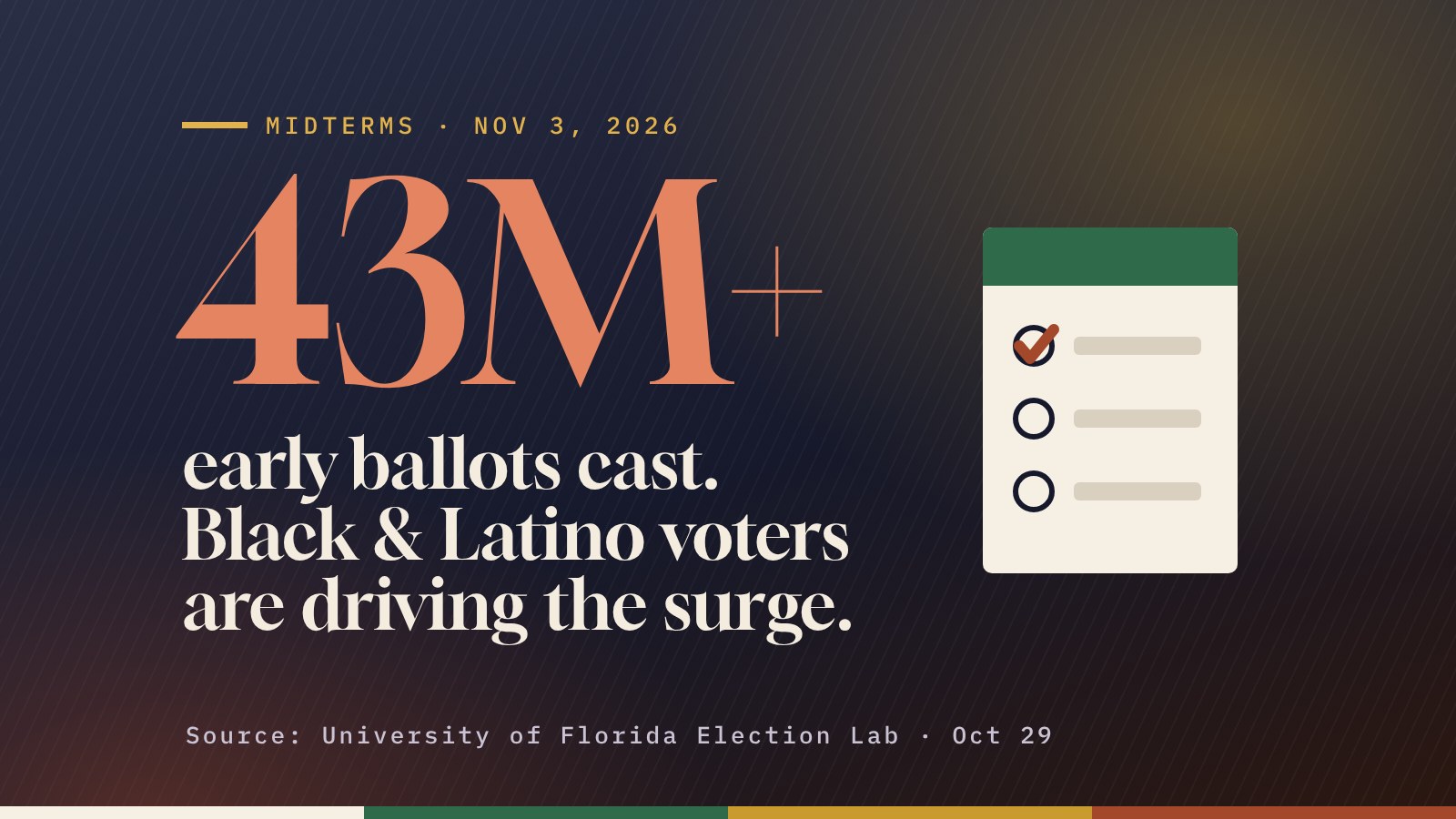
An independent look at early voting data ahead of the November 3, 2026, midterm elections reveals that a significant surge in participation among Black and Hispanic communities is shaping up to be one of the cycle’s defining narratives. Data from the University of Florida Election Lab shows record-breaking early participation, with more than 43 million ballots already cast nationwide. This massive demographic mobilization is shifting the electoral math across localized House districts and statewide Senate battles, putting Democrats in a prime position to reclaim the House and paving a direct path for current House Minority Leader Hakeem Jeffries to potentially become the first African American Speaker of the House in U.S. history.
The Turnout Shift: Reversing the 2024 Blueprint
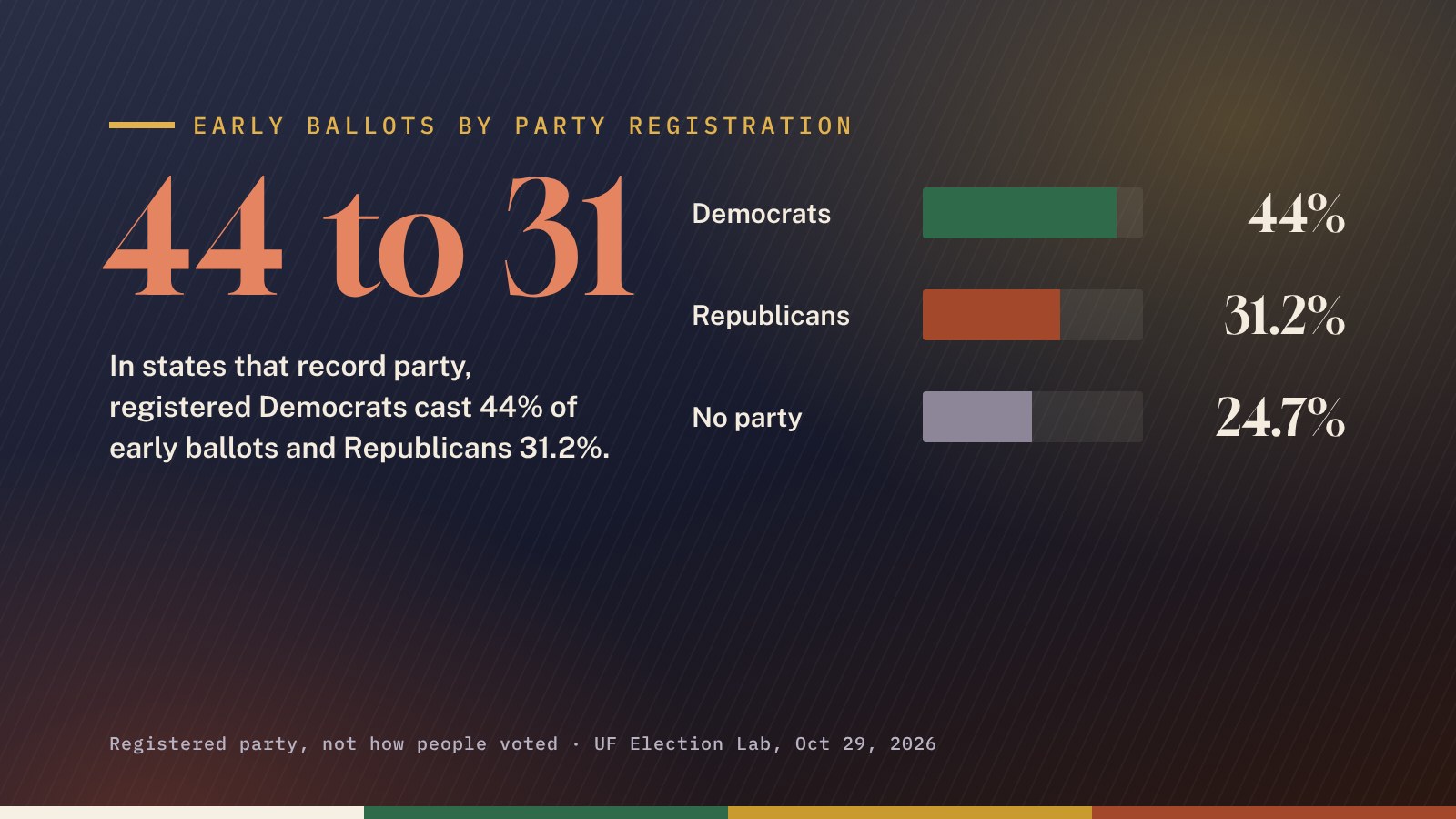
The defining characteristic of this early voting window is the stark increase in non-white voter participation relative to the last election cycle. After notable alignment shifts seen in 2024, data collected by the Democratic data firm TargetSmart indicates that Hispanic and Latino early voting is outpacing 2022 midterm levels dramatically. Across the country, 94% of counties are seeing Latino and Hispanic voters account for a larger share of the early electorate than they did four years ago. Concurrently, Black voter participation has hit historic heights, particularly across southern and border states. In states that track formal party affiliation among early voters, registered Democrats represent roughly 44% of early ballots cast compared to 31.2% for Republicans, presenting a substantial built-in head start for the Democratic coalition.
Geographic Impacts: Key Battlegrounds
While the national shift is notable, the true impact of the Black and Latino voter surge is concentrated within specific geographic battlegrounds:
- Texas: The Lone Star State has already surpassed its 2022 early voting totals by approximately 1.75 million voters. A significant driver is the massive boom in counties along the Mexico border that are more than 90% Hispanic, with some areas on pace to beat their entire 2022 turnout during the early voting period alone.
- North Carolina & Georgia: Tracking from the University of Florida Election Lab notes that Hispanic early vote participation is outperforming 2022 levels by three to four times. Simultaneously, Black turnout has surged at striking numbers, while early participation among white voters has flattened or lagged behind past midterm baselines.
- The Mid-Atlantic & West: TargetSmart data shows massive, triple-digit early voting percentage increases among Hispanic voters in states like Maryland (up 184%) alongside critical seat-shifting jumps in Virginia (up 86%), New York (up 71%), and California (up 44%) compared to this point in 2022.
Reclaiming the House: The Data Map to Speaker Jeffries
The surging turnout among Black and Latino voters acts as the primary vehicle for Democrats seeking to flip the House of Representatives. Because control of the House is determined by localized, district-level margins, the concentrated mobilization of minority voters in diverse suburbs and urban edges is placing heavy pressure on vulnerable Republican incumbents. Non-partisan trackers and major models currently give Democrats an overwhelming edge, with The Economist forecasting a 95% chance of Democrats gaining control of the House of Representatives, while predictive platforms like Kalshi and Polymarket show odds exceeding 82% to 91% for a Democratic takeover.
This exact data map directly impacts the historical trajectory for Hakeem Jeffries. Because Democrats only need a razor-thin net gain of seats to capture the majority, the path to Jeffries’ speakership runs entirely through highly competitive districts where minority turnout has exploded. In New York, the 71% spike in early Hispanic voting directly impacts swing districts across Long Island and the Hudson Valley. In Virginia’s competitive suburban seats, the 86% increase in Latino turnout forms an efficient “blue wall” alongside reliable Black Democratic blocs. When Black and Latino voter enthusiasm reaches these historic thresholds, it dilutes the slim margins held by rural and conservative-leaning electorates, pointing toward the 12-to-22 seat pickup that forecasters project, well beyond the handful of seats needed to hand Jeffries the speaker’s gavel.
Impact on the U.S. Senate: A Steeper Structural Climb
While the data paints a highly favorable picture for Democrats in the House, the U.S. Senate presents an entirely different math problem where high voter turnout is colliding with deeply unfavorable state lines. Non-partisan forecasters note that while major models give Democrats an 82% chance to take the Senate due to strong individual candidate polling, the map constraints are structurally rigid.
For the Democratic party, high early participation in major urban hubs like Detroit and Atlanta is acting more as a critical defensive shield than an expanding offensive wave. High Black voter turnout is strictly required just for Democrats to preserve competitive, vulnerable seats in states that Donald Trump won heavily in 2024, such as Michigan and Georgia. Offensively, however, the massive Latino surge has expanded the map into traditionally red territory, most notably making the Texas Senate race between Democrat James Talarico and Republican Ken Paxton a highly competitive toss-up, with Talarico commanding strong odds in recent reader prediction indices.
The Analytical Caveat
Independent election researchers emphasize that early voting data remains a measure of enthusiasm rather than a definitive final outcome. Historically, registered Democrats favor early in-person or mail-in voting methods, whereas Republican voters heavily prefer to cast ballots on Election Day. While the current data provides an undisputed, diverse cushion for the Democratic coalition, the ultimate balance of Congress—and the history-making potential of Hakeem Jeffries’ speakership—depends entirely on whether the subsequent Republican Election Day turnout can blunt this early wave.
Un análisis independiente de los datos de voto anticipado de cara a las elecciones de mitad de período del 3 de noviembre de 2026 revela que un aumento significativo de la participación de las comunidades negras e hispanas se perfila como uno de los temas definitorios de este ciclo. Los datos del Laboratorio Electoral de la Universidad de Florida (University of Florida Election Lab) muestran una participación anticipada sin precedentes, con más de 43 millones de votos ya emitidos en todo el país. Esta enorme movilización demográfica está cambiando los cálculos electorales en los distritos de la Cámara de Representantes y en las contiendas estatales por el Senado, lo que coloca a los demócratas en una posición privilegiada para recuperar la Cámara y abre un camino directo para que el actual líder de la minoría, Hakeem Jeffries, pueda convertirse en el primer presidente afroestadounidense de la Cámara de Representantes en la historia de Estados Unidos.
El cambio en la participación: revirtiendo el patrón de 2024
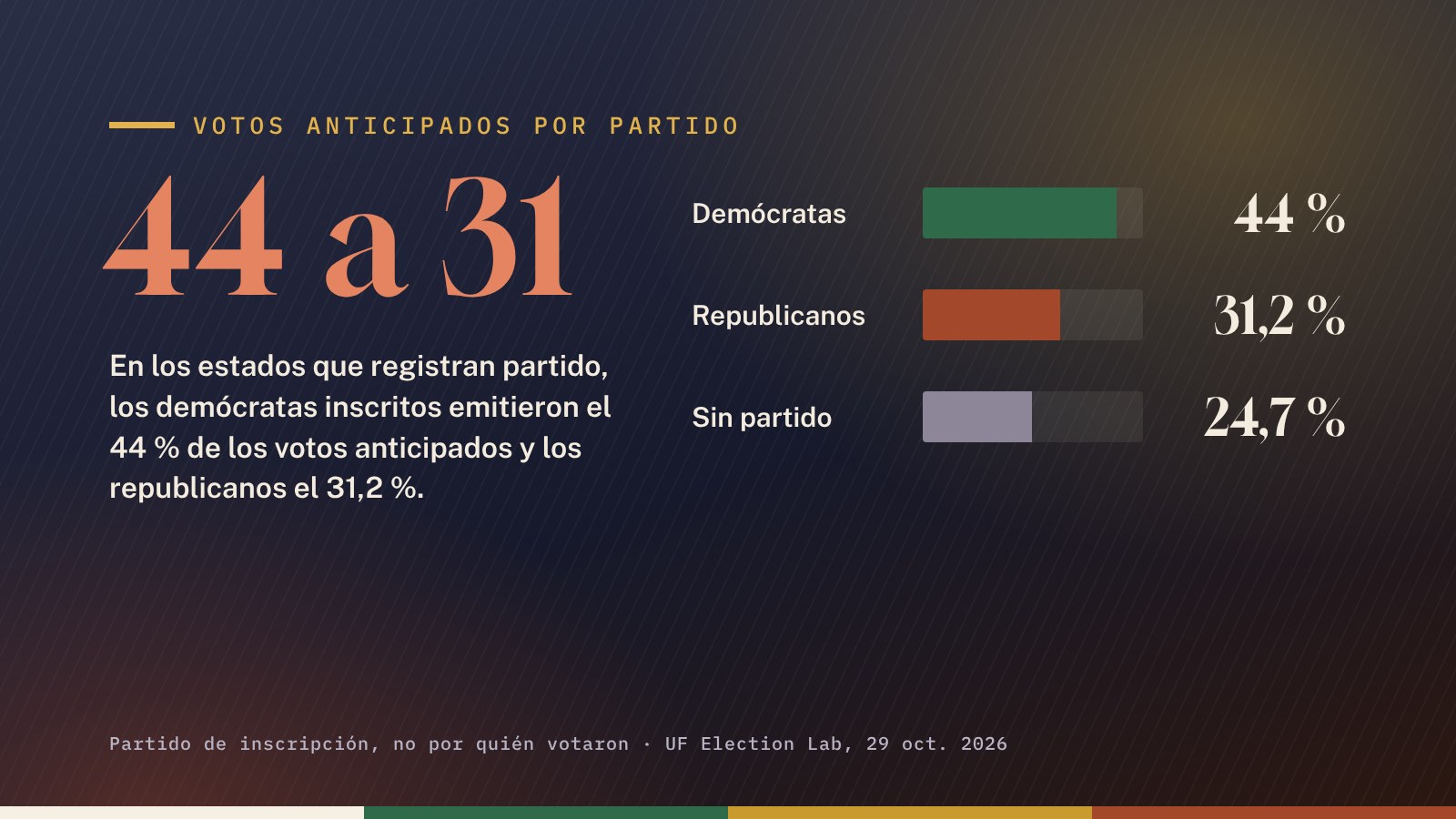
La característica que define este período de voto anticipado es el marcado aumento de la participación de votantes no blancos en comparación con el ciclo electoral anterior. Tras los notables cambios de alineamiento observados en 2024, los datos de la firma demócrata de análisis de datos TargetSmart indican que el voto anticipado hispano y latino supera ampliamente los niveles de las elecciones de mitad de período de 2022. En todo el país, en el 94 % de los condados los votantes latinos e hispanos representan una mayor proporción del electorado anticipado que hace cuatro años. Al mismo tiempo, la participación de los votantes negros ha alcanzado niveles históricos, sobre todo en los estados del sur y fronterizos. En los estados que registran la afiliación partidista de los votantes anticipados, los demócratas inscritos representan aproximadamente el 44 % de los votos anticipados, frente al 31,2 % de los republicanos, lo que le da a la coalición demócrata una ventaja inicial considerable.
Impacto geográfico: los principales campos de batalla
Aunque el cambio a nivel nacional es notable, el verdadero impacto del aumento del voto negro y latino se concentra en campos de batalla geográficos específicos:
- Texas: El estado de la estrella solitaria ya superó sus totales de voto anticipado de 2022 en aproximadamente 1,75 millones de votantes. Un factor importante es el enorme auge en los condados a lo largo de la frontera con México, con más de un 90 % de población hispana, algunos de los cuales van camino de superar toda su participación de 2022 solo durante el período de voto anticipado.
- Carolina del Norte y Georgia: El seguimiento del Laboratorio Electoral de la Universidad de Florida señala que la participación hispana en el voto anticipado supera entre tres y cuatro veces los niveles de 2022. Al mismo tiempo, la participación negra ha aumentado de forma notable, mientras que la participación anticipada de los votantes blancos se ha estancado o ha quedado por debajo de las referencias de elecciones de mitad de período anteriores.
- El Atlántico medio y el Oeste: Los datos de TargetSmart muestran enormes aumentos de tres dígitos en el voto anticipado hispano en estados como Maryland (un 184 % más), junto con saltos decisivos para varios escaños en Virginia (un 86 % más), Nueva York (un 71 % más) y California (un 44 % más) en comparación con este mismo momento de 2022.
Recuperar la Cámara: el mapa de datos hacia la presidencia de Jeffries
El aumento de la participación de votantes negros y latinos es el principal motor para los demócratas que buscan recuperar la Cámara de Representantes. Como el control de la Cámara se decide por márgenes locales, distrito por distrito, la movilización concentrada de votantes de minorías en suburbios diversos y periferias urbanas está ejerciendo una fuerte presión sobre los titulares republicanos más vulnerables. Los seguimientos no partidistas y los principales modelos dan actualmente a los demócratas una ventaja abrumadora: The Economist pronostica un 95 % de probabilidades de que los demócratas obtengan el control de la Cámara de Representantes, mientras que plataformas de predicción como Kalshi y Polymarket muestran probabilidades de entre el 82 % y el 91 % de un triunfo demócrata.
Este mismo mapa de datos influye directamente en la trayectoria histórica de Hakeem Jeffries. Como los demócratas solo necesitan una ganancia neta mínima de escaños para obtener la mayoría, el camino de Jeffries hacia la presidencia de la Cámara pasa por completo por distritos muy competitivos donde la participación de las minorías se ha disparado. En Nueva York, el aumento del 71 % en el voto anticipado hispano incide directamente en los distritos indecisos de Long Island y el valle del Hudson. En los competitivos distritos suburbanos de Virginia, el aumento del 86 % en la participación latina forma un eficaz «muro azul» junto con los fieles bloques demócratas de votantes negros. Cuando el entusiasmo de los votantes negros y latinos alcanza estos niveles históricos, diluye los estrechos márgenes de los electorados rurales y de tendencia conservadora, y apunta a la ganancia de entre 12 y 22 escaños que proyectan los pronosticadores, muy por encima del puñado de escaños necesario para entregarle a Jeffries el mazo de la presidencia de la Cámara.
El impacto en el Senado: una cuesta estructural más empinada
Aunque los datos pintan un panorama muy favorable para los demócratas en la Cámara, el Senado plantea un problema matemático totalmente distinto, en el que la alta participación choca con un mapa estatal muy desfavorable. Los pronosticadores no partidistas señalan que, aunque los principales modelos dan a los demócratas un 82 % de probabilidades de ganar el Senado gracias a las buenas encuestas de sus candidatos, las limitaciones del mapa son estructuralmente rígidas.
Para el Partido Demócrata, la alta participación anticipada en grandes centros urbanos como Detroit y Atlanta funciona más como un escudo defensivo fundamental que como una ola ofensiva en expansión. Una alta participación de votantes negros es imprescindible solo para que los demócratas conserven escaños competitivos y vulnerables en estados que Donald Trump ganó con holgura en 2024, como Michigan y Georgia. En el plano ofensivo, sin embargo, el enorme aumento del voto latino ha ampliado el mapa hacia territorio tradicionalmente republicano, sobre todo al convertir la contienda por el Senado en Texas entre el demócrata James Talarico y el republicano Ken Paxton en una carrera muy reñida, en la que Talarico tiene buenas probabilidades según los índices de predicción más recientes.
La advertencia analítica
Los investigadores electorales independientes subrayan que los datos del voto anticipado siguen siendo una medida de entusiasmo y no un resultado final definitivo. Históricamente, los demócratas inscritos prefieren votar de forma anticipada en persona o por correo, mientras que los votantes republicanos prefieren mayoritariamente hacerlo el día de las elecciones. Aunque los datos actuales ofrecen un colchón claro y diverso para la coalición demócrata, el equilibrio final del Congreso, y la posibilidad histórica de que Hakeem Jeffries presida la Cámara, depende por completo de si la participación republicana posterior, el día de las elecciones, logra frenar esta ola anticipada.
ALAPA, the Afro-Latino Association for Policy & Advocacy, is a New York nonprofit for Afro-Latinos across the Americas and the Caribbean.ALAPA, la Afro-Latino Association for Policy & Advocacy, es una organización sin fines de lucro de Nueva York para la comunidad afrolatina de las Américas y el Caribe.